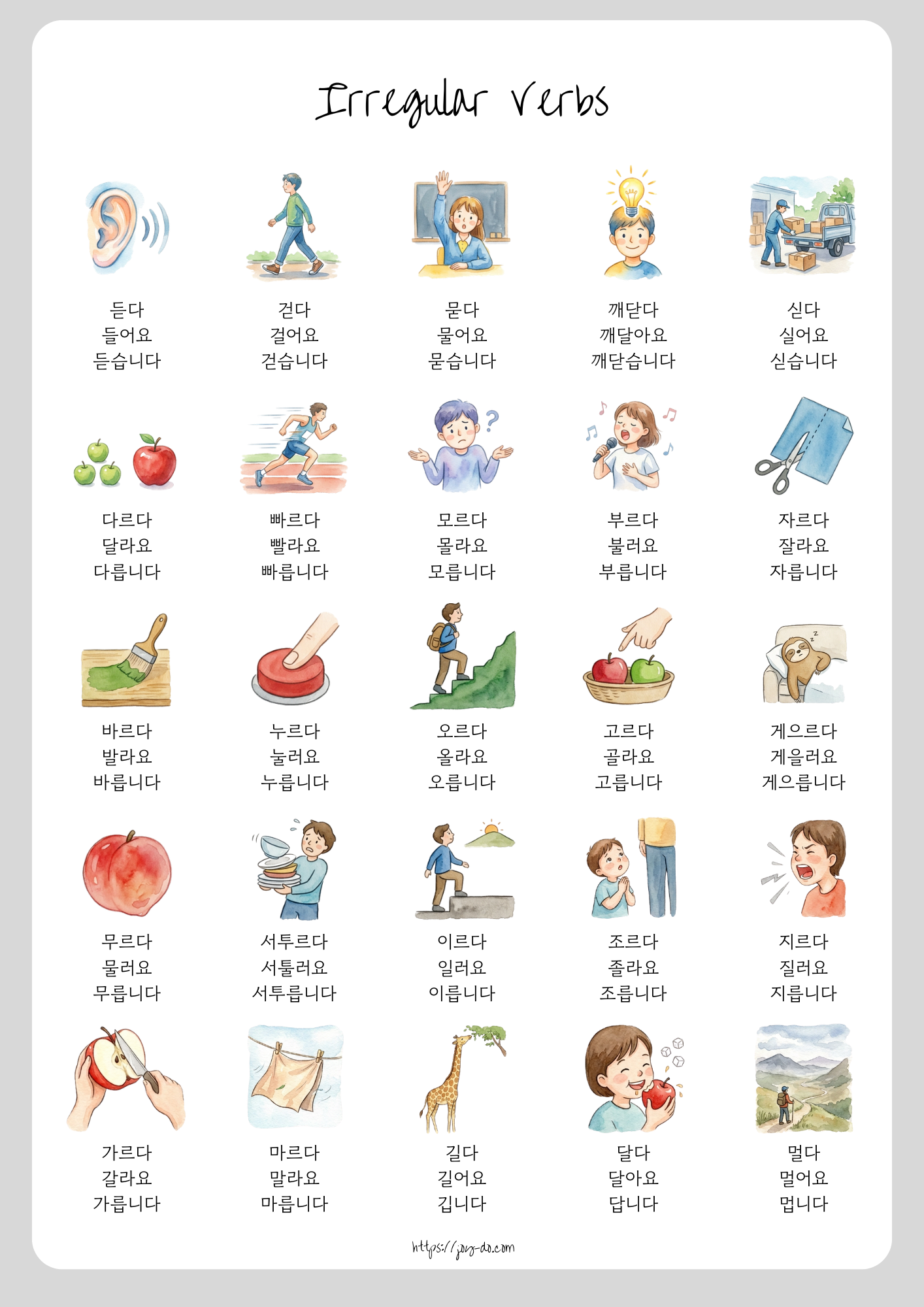
Korean textbooks typically cover seven major types of irregular verbs. While other types, such as the ‘우/오’ or ‘러’ irregulars, do exist, they occur so infrequently in daily usage that I don’t generally recommend prioritizing them.
According to research, there is an optimal order for introducing irregular verbs to beginners. Below, I’ve outlined that sequence along with the frequency of irregular predicates found in textbooks to help guide your studies.
Recommended Learning Order for Beginners
- ‘ㅡ’ Dropping Irregulars
- ‘ㅂ’ Dropping Irregulars
- ‘ㄹ’ Doubling Irregulars / ‘ㄹ’ Dropping Irregulars / ‘ㄷ’ Changing Irregulars
- ‘ㅅ’ Dropping Irregulars
- ‘ㅎ’ Dropping Irregulars
Frequency Analysis of Irregular Verbs in Textbooks
- ‘ㄹ’ Dropping Irregulars (401,186)
- ‘ㄹ’ Doubling Irregulars (149,746)
- ‘ㅡ’ Dropping Irregulars (135,378)
- ‘ㅎ’ Dropping Irregulars (109,350)
- ‘ㅂ’ Dropping Irregulars (100,746)
- ‘ㄷ’ Changing Irregulars (32,612)
- ‘ㅅ’ Dropping Irregulars (19,066)
- ‘러’ Irregulars (14,758)
- ‘우/오’ Irregulars (0)
‘ㅡ’ Dropping Irregulars
When the verb stem ends with the vowel ‘ㅡ’ and meets a verb ending that starts with a vowel, the vowel ‘ㅡ’ drops.

When there is the binding ending ‘-으-‘ coming after the verb stem, the ending ‘-으-‘ drops.

| 동사 & 형용사 | -아/어요 | -ㅂ/습니다 | -았/었어요 | -ㄹ/을 거예요 | -아/어서 | -(으)면 | -고 |
| 아프다 sick | 아파요 | 아픕니다 | 아팠어요 | 아플 거예요 | 아파서 | 아프면 | 아프고 |
| 예쁘다 pretty | 예뻐요 | 예쁩니다 | 예뻤어요 | 예쁠 거예요 | 예뻐서 | 예쁘면 | 예쁘고 |
| 바쁘다 busy | 바빠요 | 바쁩니다 | 바빴어요 | 바쁠 거예요 | 바빠서 | 바쁘면 | 바쁘고 |
| 슬프다 sad | 슬퍼요 | 슬픕니다 | 슬펐어요 | 슬플 거예요 | 슬퍼서 | 슬프면 | 슬프고 |
| 기쁘다 happy | 기뻐요 | 기쁩니다 | 기뻤어요 | 기쁠 거예요 | 기뻐서 | 기쁘면 | 기쁘고 |
| 나쁘다 bad | 나빠요 | 나쁩니다 | 나빴어요 | 나쁠 거예요 | 나빠서 | 나쁘면 | 나쁘고 |
| 크다 big | 커요 | 큽니다 | 컸어요 | 클 거예요 | 커서 | 크면 | 크고 |
| 배고프다 hungry | 배고파요 | 배고픕니다 | 배고팠어요 | 배고플 거예요 | 배고파서 | 배고프면 | 배고프고 |
| 쓰다 to write to use bitter | 써요 | 씁니다 | 썼어요 | 쓸 거예요 | 써서 | 쓰면 | 쓰고 |
| 끄다 to turn off | 꺼요 | 끕니다 | 껐어요 | 끌 거예요 | 꺼서 | 끄면 | 끄고 |
| 잠그다 to lock | 잠가요 | 잠급니다 | 잠갔어요 | 잠글 거예요 | 잠가서 | 잠그면 | 잠그고 |
| 모으다 to collect; gather | 모아요 | 모읍니다 | 모았어요 | 모을 거예요 | 모아서 | 모으면 | 모으고 |
| 치르다 to experience, to pay | 치러요 | 치릅니다 | 치렀어요 | 치를 거예요 | 치러서 | 치르면 | 치르고 |
‘ㅂ’ Dropping Irregulars
When the verb stem ends with the consonant ‘ㅂ’ and a vowel comes after the stem, ‘ㅂ’ drops and then ‘우’ is added.

When there is the binding ending ‘-으-‘ coming after the stem, the ending ‘-으-‘ drops.
The points of contact where the sound /우/ and /으/ occur are duplicated while these two vowels have only one distinction: /우/ is rounded while /으/ is unrounded.

| 동사 & 형용사 | -아/어요 | -ㅂ/습니다 | -았/었어요 | -ㄹ/을 거예요 | -아/어서 | -(으)면 | -고 |
| 춥다 cold | 추워요 | 춥습니다 | 추웠어요 | 추울 거예요 | 추워서 | 추우면 | 춥고 |
| 덥다 hot | 더워요 | 덥습니다 | 더웠어요 | 더울 거예요 | 더워서 | 더우면 | 덥고 |
| 아름답다 beautiful | 아름다워요 | 아름답습니다 | 아름다웠어요 | 아름다울 거예요 | 아름다워서 | 아름다우면 | 아름답고 |
| 무겁다 heavy | 무거워요 | 무겁습니다 | 무거웠어요 | 무거울 거예요 | 무거워서 | 무거우면 | 무겁고 |
| 가볍다 light | 가벼워요 | 가볍습니다 | 가벼웠어요 | 가벼울 거예요 | 가벼워서 | 가벼우면 | 가볍고 |
| 어렵다 difficult | 어려워요 | 어렵습니다 | 어려웠어요 | 어려울 거예요 | 어려워서 | 어려우면 | 어렵고 |
| 쉽다 easy | 쉬워요 | 쉽습니다 | 쉬웠어요 | 쉬울 거예요 | 쉬워서 | 쉬우면 | 쉽고 |
| 가깝다 close | 가까워요 | 가깝습니다 | 가까웠어요 | 가까울 거예요 | 가까워서 | 가까우면 | 가깝고 |
| 무섭다 scary | 무서워요 | 무섭습니다 | 무서웠어요 | 무서울 거예요 | 무서워서 | 무서우면 | 무섭고 |
| 맵다 spicy | 매워요 | 맵습니다 | 매웠어요 | 매울 거예요 | 매워서 | 매우면 | 맵고 |
| 귀엽다 cute | 귀여워요 | 귀엽습니다 | 귀여웠어요 | 귀여울 거예요 | 귀여워서 | 귀여우면 | 귀엽고 |
| 눕다 to lie | 누워요 | 눕습니다 | 누웠어요 | 누울 거예요 | 누워서 | 누우면 | 눕고 |
| 돕다 to help | 도와요 | 돕습니다 | 도왔어요 | 도울 거예요 | 도와서 | 도우면 | 돕고 |
| 즐겁다 enjoyable | 즐거워요 | 즐겁습니다 | 즐거웠어요 | 즐거울 거예요 | 즐거워서 | 즐거우면 | 즐겁고 |
| 새롭다 fresh, new | 새로워요 | 새롭습니다 | 새로웠어요 | 새로울 거예요 | 새로워서 | 새로우면 | 새롭고 |
| 부끄럽다 shy | 부끄러워요 | 부끄럽습니다 | 부끄러웠어요 | 부끄러울 거예요 | 부끄러워서 | 부끄러우면 | 부끄럽고 |
| 줍다 to pick up | 주워요 | 줍습니다 | 주웠어요 | 주울 거예요 | 주워서 | 주우면 | 줍고 |
| 미끄럽다 slippery | 미끄러워요 | 미끄럽습니다 | 미끄러웠어요 | 미끄러울 거예요 | 미끄러워서 | 미끄러우면 | 미끄럽고 |
‘ㄹ’ Doubling Irregulars
When the verb stem that ends with ‘르’ and a vowel comes after the stem, ‘ㅡ’ drops and another ‘ㄹ’ is added to the stem.

When there is the binding ending ‘-으-‘ coming after the stem, the ending ‘-으-‘ drops.

| 동사 & 형용사 | -아/어요 | -ㅂ/습니다 | -았/었어요 | -ㄹ/을 거예요 | -아/어서 | -(으)면 | -고 |
| 다르다 different | 달라요 | 다릅니다 | 달랐어요 | 다를 거예요 | 달라서 | 다르면 | 다르고 |
| 빠르다 fast | 빨라요 | 빠릅니다 | 빨랐어요 | 빠를 거예요 | 빨라서 | 빠르면 | 빠르고 |
| 모르다 not to know | 몰라요 | 모릅니다 | 몰랐어요 | 모를 거예요 | 몰라서 | 모르면 | 모르고 |
| 부르다 to call | 불러요 | 부릅니다 | 불렀어요 | 부를 거예요 | 불러서 | 부르면 | 부르고 |
| 자르다 to cut | 잘라요 | 자릅니다 | 잘랐어요 | 자를 거예요 | 잘라서 | 자르면 | 자르고 |
| 바르다 to apply (lotion) | 발라요 | 바릅니다 | 발랐어요 | 바를 거예요 | 발라서 | 바르면 | 바르고 |
| 누르다 to push (button) | 눌러요 | 누릅니다 | 눌렀어요 | 누를 거예요 | 눌러서 | 누르면 | 누르고 |
| 오르다 to rise; to go up | 올라요 | 오릅니다 | 올랐어요 | 오를 거예요 | 올라서 | 오르면 | 오르고 |
| 고르다 to choose | 골라요 | 고릅니다 | 골랐어요 | 고를 거예요 | 골라서 | 고르면 | 고르고 |
| 게으르다 lazy | 게을러요 | 게으릅니다 | 게을렀어요 | 게으를 거예요 | 게을러서 | 게으르면 | 게으르고 |
| 무르다 soft to return | 물러요 | 무릅니다 | 물렀어요 | 무를 거예요 | 물러서 | 무르면 | 무르고 |
| 불사르다 to burn out | 불살라요 | 불사릅니다 | 불살랐어요 | 불사를 거예요 | 불살라서 | 불사르면 | 불사르고 |
| 서투르다 clumsy, unskilled | 서툴러요 | 서투릅니다 | 서툴렀어요 | 서툴 거예요 | 서툴러서 | 서투르면 (=서툴면) | 서투르고 (=서툴고) |
| 이르다 early, to tell | 일러요 | 이릅니다 | 일렀어요 | 이를 거예요 | 일러서 | 이르면 | 이르고 |
| 조르다 to beg, to tighten | 졸라요 | 조릅니다 | 졸랐어요 | 조를 거예요 | 졸라서 | 조르면 | 조르고 |
| 지르다 to yell | 질러요 | 지릅니다 | 질렀어요 | 지를 거예요 | 질러서 | 지르면 | 지르고 |
| 가르다 to divide | 갈라요 | 가릅니다 | 갈랐어요 | 가를 거예요 | 갈라서 | 가르면 | 가르고 |
| 나르다 to carry | 날라요 | 나릅니다 | 날랐어요 | 나를 거예요 | 날라서 | 나르면 | 나르고 |
| 들르다 to stop by | 들러요 | 들릅니다 | 들렀어요 | 들를 거예요 | 들러서 | 들르면 | 들르고 |
| 마르다 to dry up | 말라요 | 마릅니다 | 말랐어요 | 마를 거예요 | 말라서 | 마르면 | 마르고 |
‘ㄹ’ Dropping Irregulars
When the verb stem with ‘ㄹ’ in the end comes before endings that start with ‘ㄴ, ㅂ, ㅅ, ㄹ’, the last consonant (batchim) ‘ㄹ’ drops.

When endings that have the binding ending ‘-으-‘ is attached to the stem, the ending ‘-으-‘ drops.

When ‘-(으)러’ or ‘-(으)면’ is attached to the stem, ‘ㄹ’ does not drop itself. Only binding ending ‘-으-‘ drops.

| 동사 & 형용사 | -아/어요 | -ㅂ/습니다 | -았/었어요 | -ㄹ/을 거예요 | -아/어서 | -(으)면 | -고 |
| 길다 long | 길어요 | 깁니다 | 길었어요 | 길 거예요 | 길어서 | 길면 | 길고 |
| 달다 sweet | 달아요 | 답니다 | 달았어요 | 달 거예요 | 달아서 | 달면 | 달고 |
| 멀다 far | 멀어요 | 멉니다 | 멀었어요 | 멀 거예요 | 멀어서 | 멀면 | 멀고 |
| 힘들다 tough | 힘들어요 | 힘듭니다 | 힘들었어요 | 힘들 거예요 | 힘들어서 | 힘들면 | 힘들고 |
| 만들다 to make | 만들어요 | 만듭니다 | 만들었어요 | 만들 거예요 | 만들어서 | 만들면 | 만들고 |
| 울다 to cry | 울어요 | 웁니다 | 울었어요 | 울 거예요 | 울어서 | 울면 | 울고 |
| 살다 to live | 살아요 | 삽니다 | 살았어요 | 살 거예요 | 살아서 | 살면 | 살고 |
| 알다 to know | 알아요 | 압니다 | 알았어요 | 알 거예요 | 알아서 | 알면 | 알고 |
| 열다 to open | 열어요 | 엽니다 | 열었어요 | 열 거예요 | 열어서 | 열면 | 열고 |
| 팔다 to sell | 팔아요 | 팝니다 | 팔았어요 | 팔 거예요 | 팔아서 | 팔면 | 팔고 |
| 들다 to enter, to lift | 들어요 | 듭니다 | 들었어요 | 들 거예요 | 들어서 | 들면 | 들고 |
| 날다 to fly | 날아요 | 납니다 | 날았어요 | 날 거예요 | 날아서 | 날면 | 날고 |
| 물다 to bite | 물어요 | 뭅니다 | 물었어요 | 물 거예요 | 물어서 | 물면 | 물고 |
| 풀다 to solve; to undo | 풀어요 | 풉니다 | 풀었어요 | 풀 거예요 | 풀어서 | 풀면 | 풀고 |
| 벌다 to earn (money); to save (time) | 벌어요 | 법니다 | 벌었어요 | 벌 거예요 | 벌어서 | 벌면 | 벌고 |
| 가늘다 thin | 가늘어요 | 가늡니다 | 가늘었어요 | 가늘 거예요 | 가늘어서 | 가늘면 | 가늘고 |
| 말다 not to do, to stop | 말아요 | 맙니다 | 말았어요 | 말 거예요 | 말아서 | 말면 | 말고 |
| 밀다 to push | 밀어요 | 밉니다 | 밀었어요 | 밀 거예요 | 밀어서 | 밀면 | 밀고 |
| 불다 to blow | 불어요 | 붑니다 | 불었어요 | 불 거예요 | 불어서 | 불면 | 불고 |
| 졸다 to nod, to doze off | 졸아요 | 좁니다 | 졸았어요 | 졸 거예요 | 졸아서 | 졸면 | 졸고 |
| 절다 to limp | 절어요 | 접니다 | 절었어요 | 절 거예요 | 절어서 | 절면 | 절고 |
‘ㄷ’ Changing Irregulars (ㄷ to ㄹ)
Irregulars
When the verb stem that ends with consonant ‘ㄷ’ and a vowel comes after the stem, it drops ‘ㄷ’ and then ‘ㄹ’ is added.

| 동사 & 형용사 | -아/어요 | -ㅂ/습니다 | -았/었어요 | -ㄹ/을 거예요 | -아/어서 | -(으)면 | -고 |
| 듣다 to listen | 들어요 | 듣습니다 | 들었어요 | 들을 거예요 | 들어서 | 들으면 | 듣고 |
| 걷다 to walk | 걸어요 | 걷습니다 | 걸었어요 | 걸을 거예요 | 걸어서 | 걸으면 | 걷고 |
| 묻다 to ask | 물어요 | 묻습니다 | 물었어요 | 물을 거예요 | 물어서 | 물으면 | 묻고 |
| 깨닫다 to realize | 깨달아요 | 깨닫습니다 | 깨달았어요 | 깨달을 거예요 | 깨달아서 | 깨달으면 | 깨닫고 |
| 싣다 to load | 실어요 | 싣습니다 | 실었어요 | 실을 거예요 | 실어서 | 실으면 | 싣고 |
Regulars
Please be aware of that there are many regular verbs whose stems end with consonant ‘ㄷ.’
| 동사 & 형용사 | -아/어요 | -ㅂ/습니다 | -았/었어요 | -ㄹ/을 거예요 | -아/어서 | -(으)면 | -고 |
| 받다 to receive | 받아요 | 받습니다 | 받았어요 | 받을 거예요 | 받아서 | 받으면 | 받고 |
| 닫다 to close | 닫아요 | 닫습니다 | 닫았어요 | 닫을 거예요 | 닫아서 | 닫으면 | 닫고 |
| 믿다 to trust | 믿어요 | 믿습니다 | 믿었어요 | 믿을 거예요 | 믿어서 | 믿으면 | 믿고 |
| 묻다 to bury | 묻어요 | 묻습니다 | 묻었어요 | 묻을 거예요 | 묻어서 | 묻으면 | 묻고 |
| 굳다 harden | 굳어요 | 굳습니다 | 굳었어요 | 굳을 거예요 | 굳어서 | 굳으면 | 굳고 |
| 돋다 to rise | 돋아요 | 돋습니다 | 돋았어요 | 돋을 거예요 | 돋아서 | 돋으면 | 돋고 |
| 쏟다 to spill | 쏟아요 | 쏟습니다 | 쏟았어요 | 쏟을 거예요 | 쏟아서 | 쏟으면 | 쏟고 |
| 얻다 to get, to obtain | 얻어요 | 얻습니다 | 얻었어요 | 얻을 거예요 | 얻어서 | 얻으면 | 얻고 |
‘ㅅ’ Dropping Irregulars
Irregulars
When a stem that ends with the consonant ‘ㅅ’ (batchim) and a vowel comes after the stem, the batchim ‘ㅅ’ drops.

| 동사 & 형용사 | -아/어요 | -ㅂ/습니다 | -았/었어요 | -ㄹ/을 거예요 | -아/어서 | -(으)면 | -고 |
| 낫다 to recover to be better | 나아요 | 낫습니다 | 나았어요 | 나을 거예요 | 나아서 | 나으면 | 낫고 |
| 짓다 to creat; to build | 지어요 | 짓습니다 | 지었어요 | 지을 거예요 | 지어서 | 지으면 | 짓고 |
| 잇다 to connect | 이어요 | 잇습니다 | 이었어요 | 이을 거에요 | 이어서 | 이으면 | 잇고 |
| 긋다 to draw | 그어요 | 긋습니다 | 그었어요 | 그을 거예요 | 그어서 | 그으면 | 긋고 |
| 붓다 to pour, to swell | 부어요 | 붓습니다 | 부었어요 | 부을 거예요 | 부어서 | 부으면 | 붓고 |
| 젓다 to stir | 저어요 | 젓습니다 | 저었어요 | 저을 거예요 | 저어서 | 저으면 | 젓고 |
Regulars
There also are many regular verbs whose stems end with consonant ‘ㅅ.’
| 동사 & 형용사 | -아/어요 | -ㅂ/습니다 | -았/었어요 | -ㄹ/을 거예요 | -아/어서 | -(으)면 | -고 |
| 웃다 to laugh | 웃어요 | 웃습니다 | 웃었어요 | 웃을 거예요 | 웃어서 | 웃으면 | 웃고 |
| 벗다 to take off | 벗어요 | 벗습니다 | 벗었어요 | 벗을 거예요 | 벗어서 | 벗으면 | 벗고 |
| 씻다 to wash | 씻어요 | 씻습니다 | 씻었어요 | 씻을 거예요 | 씻어서 | 씻으면 | 씻고 |
| 빗다 to brush, to comb | 빗어요 | 빗습니다 | 빗었어요 | 빗을 거예요 | 빗어서 | 빗으면 | 빗고 |
| 빼앗다 to take away | 빼앗아요 | 빼앗습니다 | 빼앗았어요 | 빼앗을 거예요 | 빼앗아서 | 빼앗으면 | 빼앗고 |
| 솟다 to soar, to rise | 솟아요 | 솟습니다 | 솟았어요 | 솟을 거예요 | 솟아서 | 솟으면 | 솟고 |
‘ㅎ’ Dropping Irregulars
Irregulars
When the verb stem that ends with the consonant ‘ㅎ’ (batchim) and a vowel comes after the stem, the batchim ‘ㅎ’ drops while vowel ‘ㅏ’ or ‘ㅓ’ changed into ‘ㅐ.’

When the stem has vowel ‘ㅑ’ or ‘ㅕ’ with the same environment, the vowels are changed into ‘ㅒ.’


| 동사 & 형용사 | -아/어요 | -ㅂ/습니다 | -았/었어요 | -ㄹ/을 거예요 | -아/어서 | -(으)면 | -고 |
| 어떻다 how | 어때요 | 어떻습니다 | 어땠어요 | 어떨 거예요 | 어때서 | 어떠면 | 어떻고 |
| 그렇다 as such | 그래요 | 그렇습니다 | 그랬어요 | 그럴 거예요 | 그래서 | 그러면 | 그렇고 |
| 이렇다 as such | 이래요 | 이렇습니다 | 이랬어요 | 이럴 거예요 | 이래서 | 이러면 | 이렇고 |
| 저렇다 as such | 저래요 | 저렇습니다 | 저랬어요 | 저럴 거예요 | 저래서 | 저러면 | 저렇고 |
| 까맣다 black | 까매요 | 까맣습니다 | 까맸어요 | 까말 거예요 | 까매서 | 까마면 | 까맣고 |
| 노랗다 yellow | 노래요 | 노랗습니다 | 노랬어요 | 노랄 거예요 | 노래서 | 노라면 | 노랗고 |
| 빨갛다 red | 빨개요 | 빨갛습니다 | 빨갰어요 | 빨갈 거예요 | 빨개서 | 빨가면 | 빨갛고 |
| 파랗다 blue | 파래요 | 파랗습니다 | 파랬어요 | 파랄 거예요 | 파래서 | 파라면 | 파랗고 |
| 하얗다 white | 하얘요 | 하얗습니다 | 하얬어요 | 하얄 거예요 | 하얘서 | 하야면 | 하얗고 |
Regulars
There also are many regular verbs whose stems end with consonant ‘ㅎ.’
| 동사 & 형용사 | -아/어요 | -ㅂ/습니다 | -았/었어요 | -ㄹ/을 거예요 | -아/어서 | -(으)면 | -고 |
| 낳다 to give a birth | 낳아요 | 낳습니다 | 낳았어요 | 낳을 거예요 | 낳아서 | 낳으면 | 낳고 |
| 빻다 to crush, to grind | 빻아요 | 빻습니다 | 빻았어요 | 빻을 거예요 | 빻아서 | 빻으면 | 빻고 |
| 놓다 to put | 놓아요 | 놓습니다 | 놓았어요 | 놓을 거예요 | 놓아서 | 놓으면 | 놓고 |
| 좋다 to be good | 좋아요 | 좋습니다 | 좋았어요 | 좋을 거예요 | 좋아서 | 좋으면 | 좋고 |

Reference
- 백경미(2019), 한국어 용언 활용 규칙의 교재 기술 방안 연구, 영주어문학회 42, 5-32.
- 이혜영, 이임경(2013), 한국어 교육을 위한 불규칙 용언의 위계화 연구.
- 조남민(2002), 한국어 교육용 교재에 나타난 불규칙 용언에 관한 분석, 301-302.