It’s been a while, but let’s talk about pronunciation today!
Look at this word. Do you know how to say it? It’s written as “같이,” but you must say [가치]. Never [가티]!
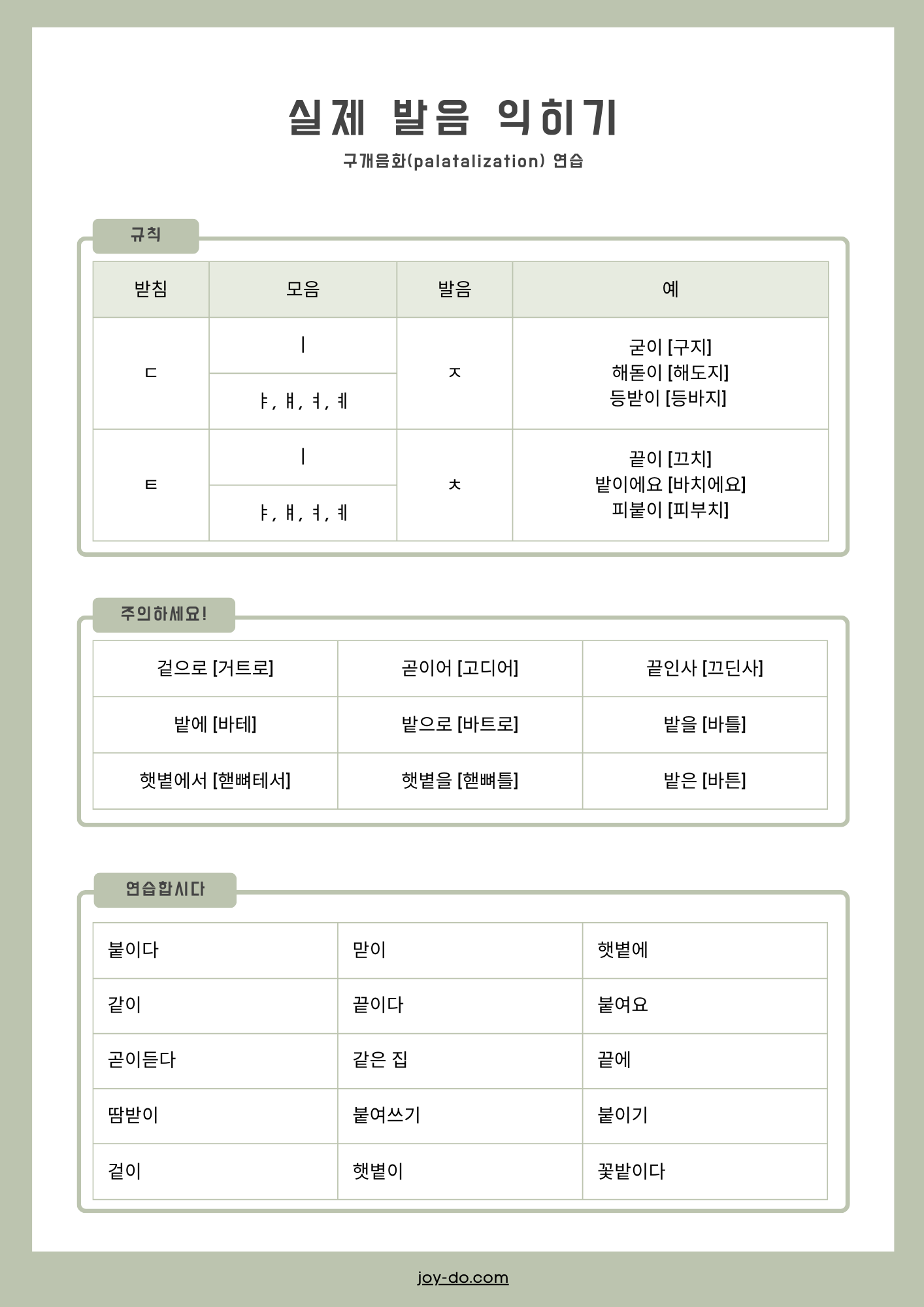
This is a special rule in Korean. Within a single meaning unit, when a word ending in the consonant ㄷ or ㅌ meets a vowel that starts with the /ㅣ/ sound, their sound changes.
Specifically, ㄷ transforms into ㅈ, and ㅌ transforms into ㅊ. The vowel starting with the /ㅣ/ sound include not only /ㅣ/, but also /ㅑ/, /ㅒ/, /ㅕ/, /ㅖ/.
It might sound like a lot to remember, but this only happens in a few specific cases. So just try to understand the logic!
- 해돋이 [해도지] – Sunrise
- 같이 [가치] – together
- 끝이에요. [끄치에요] – It’s the end.
- 붙여 주세요. [부쳐주세요] – Please paste/stick this.
If you want to memorize this, here’s a secret. This isn’t just a Korean thing. English has a very similar phenomenon!
Think about the phrase: “I don’t really get you.”
When you speak fast, you don’t say [겥-유]. Or Korean style, [게튜]. You say [게츄], right?
How about “Did you hear that?” You don’t say [디ㄷ유]. It sounds more like [디쥬].
To make the /ㄷ/, /ㅌ/, /d/ or /t/ sound, your tongue tip touches behind your upper teeth. But the /ㅣ/ sound, you have to touch the roof of your mouth using the front-middle part of your tongue.
Moving your tongue back and forth that fast is physically exhausting! So, our tongues get lazy and find a middle ground–which sounds like ㅈ, ㅊ, j, or ch.
Reference
- 케빈 강 & 해나 변(2022), 영어 발음 향상 훈련, 사람인, 205.
- Jaehoon Yeon & Lucien Brown(2011), Korean: A Comprehensive Grammar, 30-31.
Leave a Reply