Click to watch the video
In native Korean, “외” means something left alone, or being alone.
Many learners get confused with the Sino-Korean “외”, which has the exact same pronunciation but comes from a completely different root.
This native Korean “외” has already blended into various words over time, so it’s not used as an independent word on its own.
However, knowing this hidden meaning will be incredibly helpful for your vocabulary!
Let’s quickly scan through what kind of words have this root.
Don’t feel any pressure—just look through them with me!
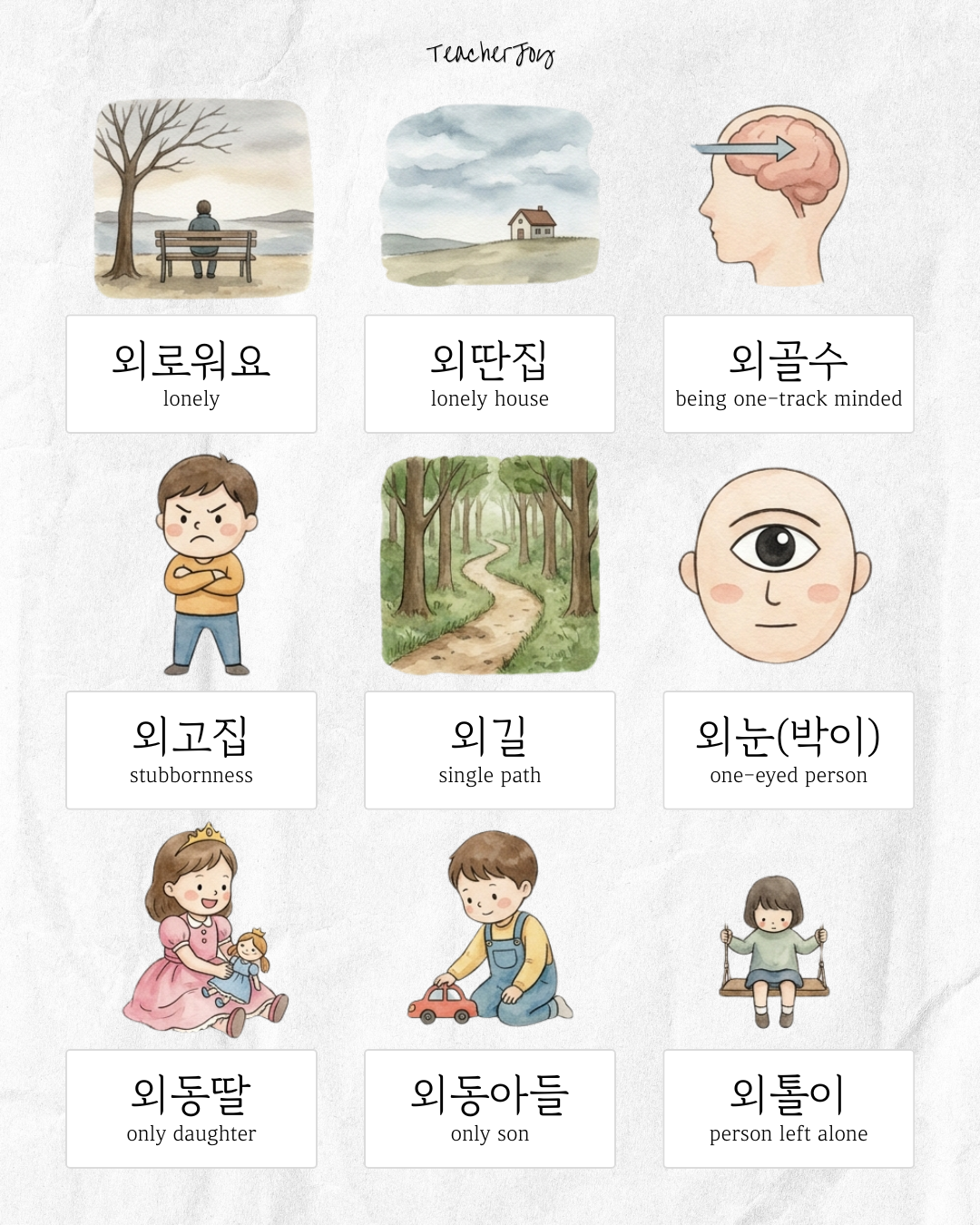
- 외롭다 (외로워요, 외롭습니다): lonely, solitary
- 외딴곳 [외딴곧]: a lonely, isolated place; out-of-the-way place
- 외골수 (외-骨髓) [외골쑤]: person with a one-track mind, being one-track minded
- 외고집 (외-固執): stubbornness, pigheaded person
- 외길: single path
- 외눈(박이): being one-eyed
- 외동딸: only daughter
- 외동아들: only son
- 외톨이 [외토리]: loner, solitary person, being left alone
Leave a Reply