Click to watch the video
You know the word “진짜,” right? It’s one of the first adverbs everyone learns in Korean. But did you know it’s actually rooted in Hanja? Today, I’ll tell you the truth behind it.
The “짜” in “진짜” was originally pronounced “자.” In Chinese, this character (子) is sometimes attached to the end of certain object nouns. Korean also has a few specific objects that adopted this Chinese influence and use the exact same character.
- 의자 (椅子) – Yǐzi (Chair)
- 탁자 (卓子) – Zhuōzi (Table)
- 상자 (箱子) – Xiāngzi (Box)
- 모자 (帽子) – Màozi (Hat)
- 판자 (板子) – Bǎnzi (Plank)
While those words are Sino-Korean, the word “진짜” itself is uniquely Korean! The “진” comes from this Hanja (眞), meaning “real,” and the “자” part was inspired by how those object names were formed.
As this word became fully “Koreanized,” its sound changed. Unlike Chinese, Korean marks the boundaries between different meanings through sound. Since “진” and “자” are two distinct units, a natural pause and tension occur between them as you speak. This tension is what transformed the soft “자” into the tensed sound “짜.”
This unique evolution gave birth to an entire family of “-짜” words.
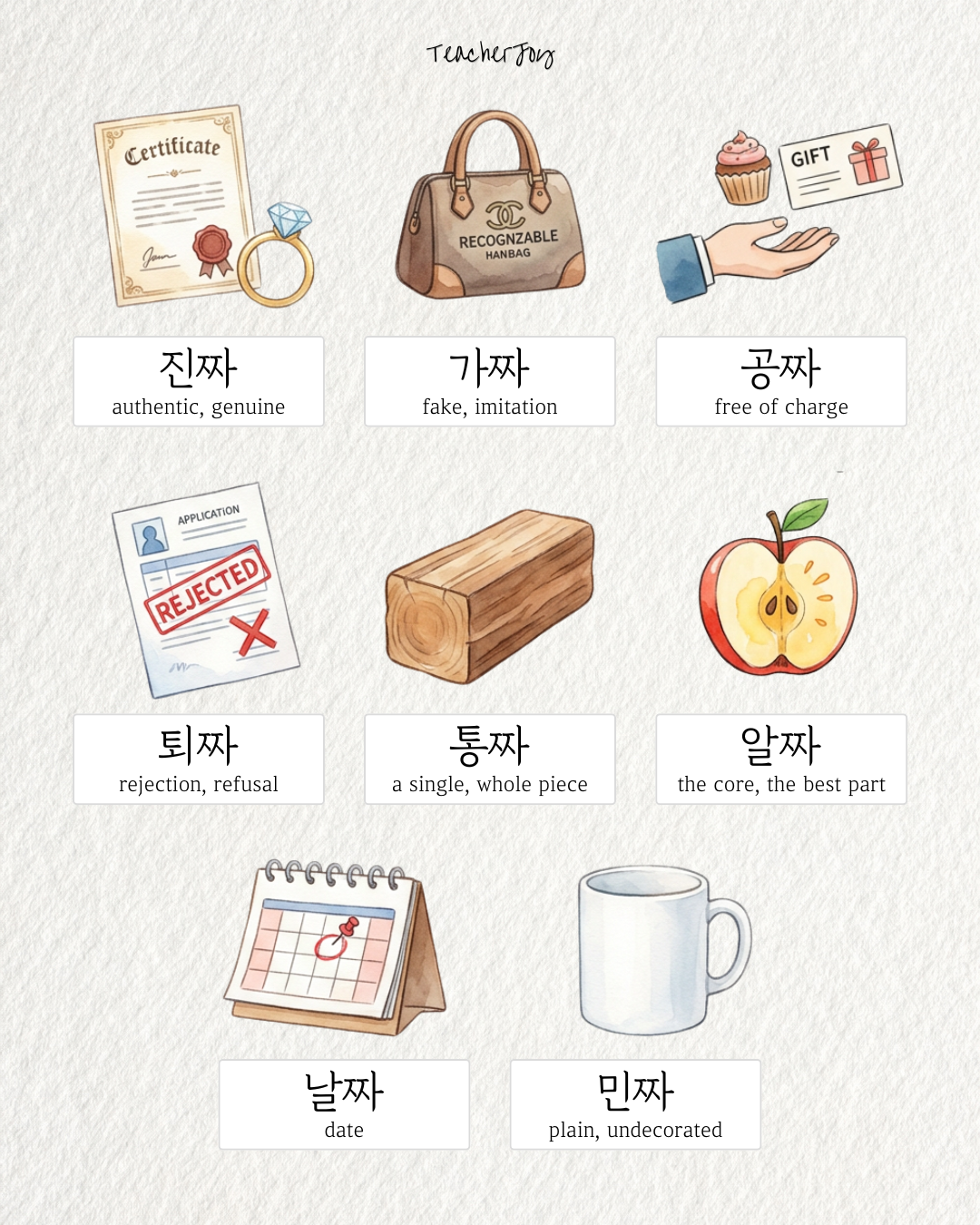
- 진짜 (眞짜): Authentic; Genuine; Really.
- Something that is neither an imitation nor fake.
- Truly, without hypocrisy or dishonesty.
- 너 진짜로 유학 갈 거야? – Are you really going to study abroad?
- 가짜 (假짜): Fake; Forgery; Imitation.
- Something which is made to look real, but is not real.
- 이거 진짜 사람이에요? 가짜 같아요! – Is this a real person? It looks fake!
- 공짜 (空짜): Free of charge; Something gained for nothing.
- Something gained free of charge.
- Something gained for free, in exchange for no power, no effort, or money.
- 세상에 공짜는 없어요. – Nothing in this world comes for free.
- 이거 저한테 공짜로 주시는 거예요? – Are you giving this to me for free?
- 퇴짜 (退짜): Rejection; Refusal.
- The act of not accepting and refusing and item, opinion, person, etc., or such an item, opinion or person.
- 어제 소개팅 남한테 퇴짜 맞았어. – I got rejected by my blind date guy yesterday.
- 통짜 (桶짜): A single, whole piece.
- A single, solid mass that hasn’t been divided or attached.
- 상의랑 하의랑 다 통짜로 붙어 있는 그 옷 이름 뭐지? – What do you call that piece of clothing where the top and bottom are all in one piece?
Even Native Korean words started using this “-짜” style!
- 알짜 (egg/core-짜): The core; the best part.
- The one, which is the most important or best, out of many of its kind.
- 제가 시험에 나오는 알짜만 알려 드릴게요. 이것만 보면 합격이에요! – I’ll give you only the essentials that will be on the exam. If you study this, you’re guaranteed to pass!
- 날짜 (day-짜): Date; a specific day.
- The day set for doing something.
- A day of the month in a certain year.
- 결혼식 날짜는 잡으셨어요? – Have you set a date for the wedding yet?
- 민짜 (plain/bare-짜): Something plain or undecorated.
- 이렇게 무늬 있는 거 말고, 민짜로 된 거 보여 주세요. – Could you show me a plain one instead of something with patterns like this?

Reference
- 국립국어원 한국어기초사전
- 하치근(2011), 우리말 파생형태론(Korean Derivational Morphology), 174.