Click to watch the video
This hanja means “round” or “ball”. If you look closely, you’ll see it’s made of two independent hanja parts. In many cases, the left side carries the overall meaning, while the right side provides the pronunciation. Though there are always exceptions!
Before this character was introduced, Koreans already had native words for “round” things. As a result. this Sino-Korean began to be used in more formal or professional contexts.
For example, the common word for a circle or round shape is “동그라미”, derived from the adjective “동그랗다”. But in a more “fancy” or technical context, like in a high school math or physics textbooks, it’s called “구”. But people don’t use it in daily life.
Another example is the eye. In everyday conversation, we just say “눈”. But in medical school, they call it “안구”. The literal, word-for-word native translation of 안구 would be “눈알,” which sounds quite informal.
However, some “구” words are used everyday because there are no native equivalents, such as “지구” or “전구”.
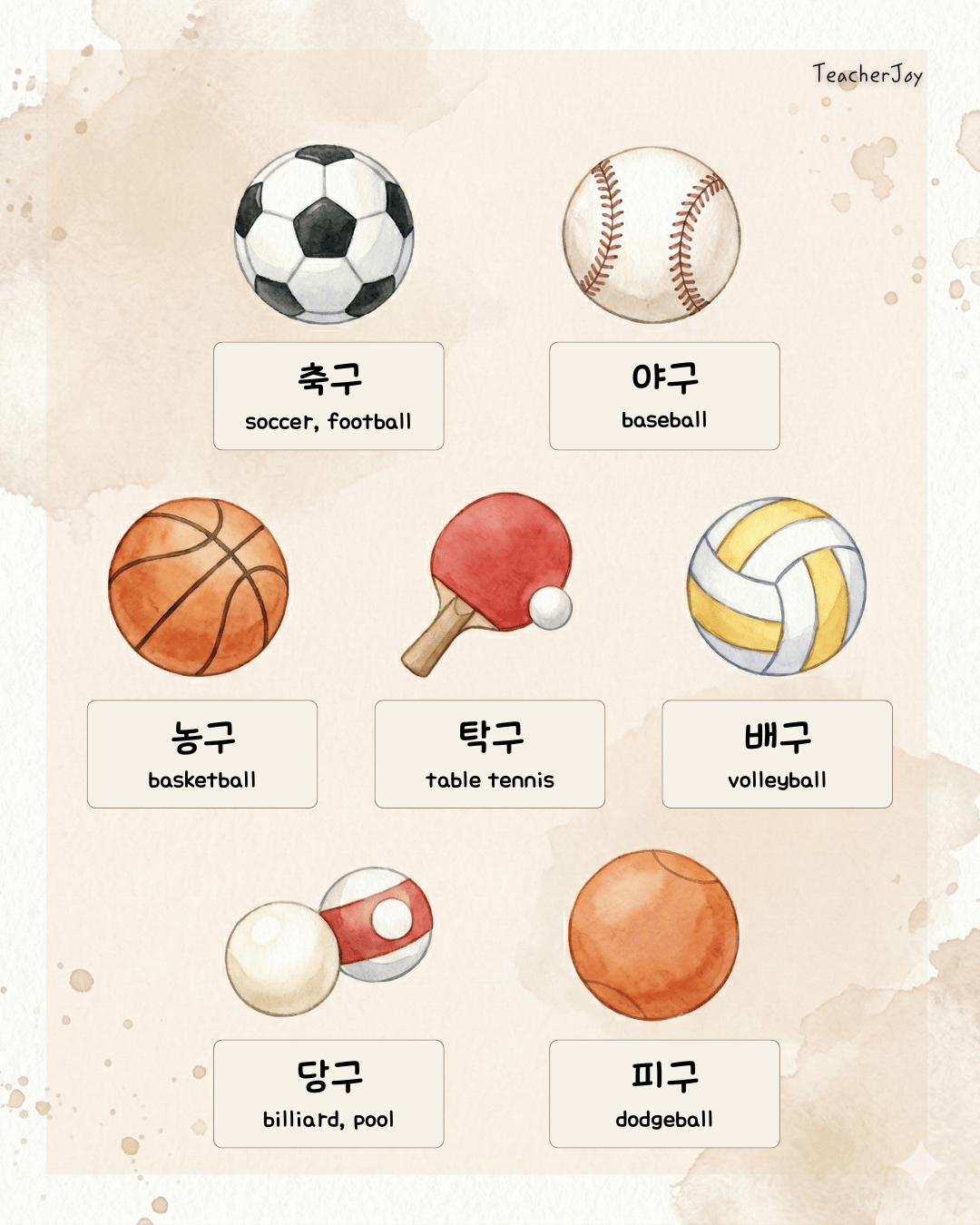
Lastly, the place where you’ll see “구” the most is in sports. These are essential Level 2 words, so make sure to memorize them:
- 축구 (蹴球): soccer / football
- 야구 (野球): baseball
- 농구 (籠球): basketball
- 탁구 (卓球): table tennis
- 배구 (排球): volleyball
- 당구 (撞球): billiards / pool
- 피구 (避球): dodgeball

Leave a Reply