
Click to watch the video
In Korea, this Hanja character is read as 대.
It refers to a high, flat place or a platform. I didn’t make this video to teach you how to write it stroke by stroke. Honestly, I’m making this because I’m a bit tired of people asking, “Wait, does 대 mean ‘Big'(大) here?” and having to explain, “No, this is a different ‘Dae’!” Let’s look at some common words where “대”(臺) actually means a platform or a stand.
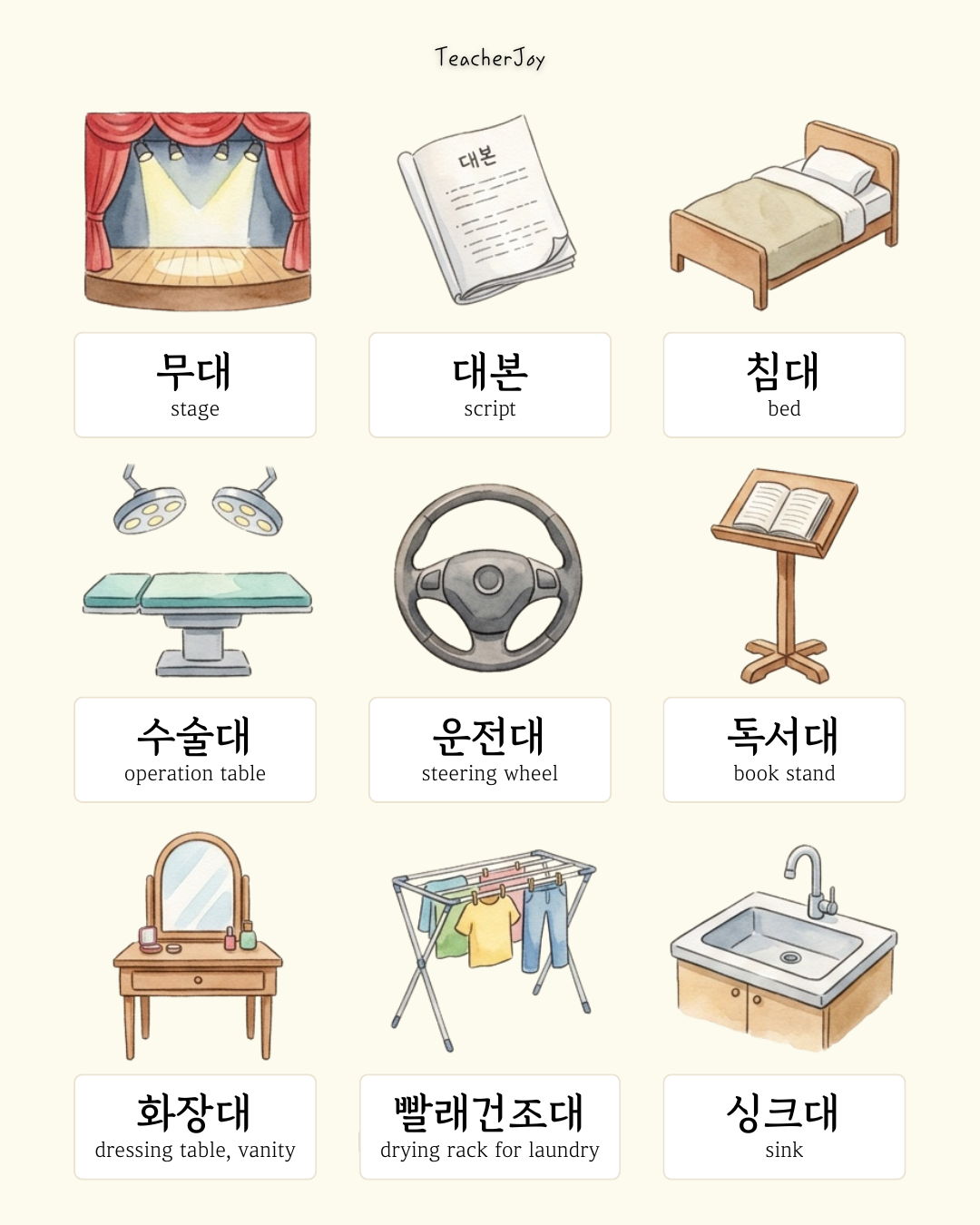
- 무대 (舞臺): stage (for performances)
- 대본 (臺本): script
- 침대 (寢臺): bed
- 수술대 (手術臺) [수술때]: operating table
- 운전대 (運轉臺) [운전때]: steering wheel
- 독서대 (讀書臺): book stand
- 화장대 (化粧臺): dressing table, vanity
- 빨래건조대 (빨래-乾燥臺): drying rack for laundry
- 싱크대 (Sink-臺): sink
- 거치대 (据置臺): stand
- 진열대 (陳列臺) [진열때]: display stand
Let’s look at 거치대 and 진열대. Depending on the context, these can refer to very specific types of stands.
First, 거치하다 is the Sino-Korean version of the native Korean verb “두다”, which means “to place” or “to set.” So, a 거치대 is “a high, flat object where you place things.” In daily life, you’ll often see a 휴대폰 거치대 or a 헤드폰 거치대.
As for 진열대, the most common example is a 상품진열대 (Product display stand) found in stores.
- 골대 (goal-臺) [꼴때]: goalpost
- 촛대 (초-臺) [촏때]: gandle holder
For 촛대, it’s a stand to hold a candle. Interestingly, back in the era of King Sejong, it was common to place the consonant “ㅅ” between two words when forming a compound noun. It acted like the word “of,” marking the boundary between the words and making the following sound tenser.
- 등대 (燈臺): lighthouse
- 분수대 (噴水臺): fountain
- 농구대 (籠球臺): basketball hoop
- 냄비받침대 (냄비-받침-臺) [냄비받침때]: potholder
- 대만 (臺灣): Taiwan
- 청와대 (靑瓦臺): The Blue House
- 해운대 (海雲臺): Haeundae
- 천문대 (天文臺): astronomical observatory
- 전망대 (展望臺): observatory, observation deck
- 탁구대 (卓球臺) [탁꾸대]: ping-pong table
