Click to watch the short lesson
Have you ever wondered how Korean verbs turn into nouns?
Let’s look at the noun-forming ending ‘-기’.
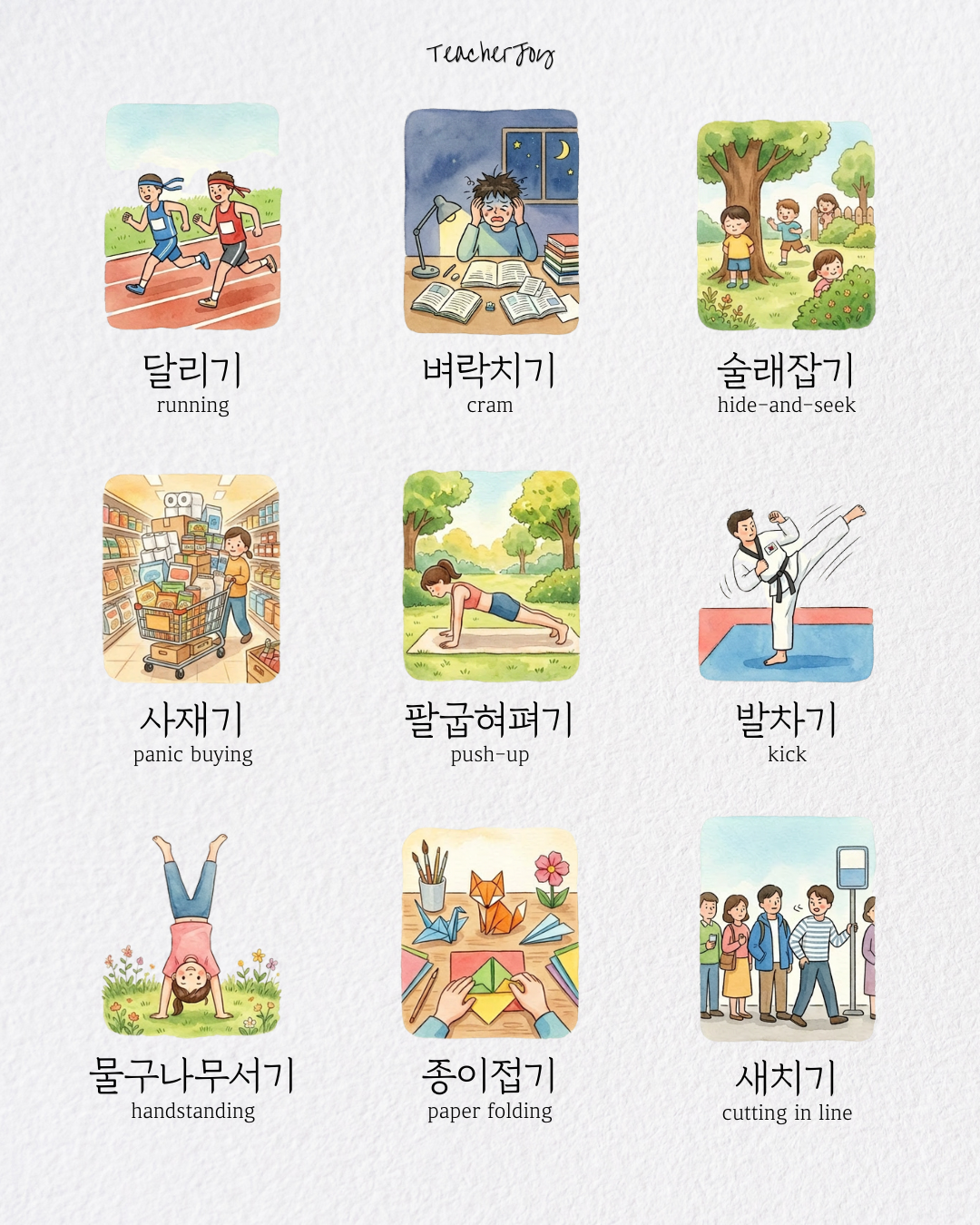
When ‘-기’ is attached to a verb stem, it transforms a temporary action into an ongoing process—kind of like the English ‘-ing’ ending.
For example, the verb stem for ‘to run’ is ‘달리-‘. Add ‘-기’, and you get 달리기. It represents the whole activity of running. The same goes for: 읽기(reading), 쓰기(writing), 듣기(listening), and 말하기(speaking).
We also use ‘-기’ to combine an entire clause into a single noun phrase. Usually, it follows the pattern of “Object + Verb Stem + -기.” Like 줄넘기(jump rope) and 글짓기(writing).
But my favorite part is when ‘-기’ attaches to adjectives to measure a scale or quality.
Just like in English where we naturally ask “How old are you?” instead of “How young?”, Korean uses the maximum point of a scale as the baseline.
So we use adjectives that mean the “most” or “biggest” to measure things:
- 크다 -> 크기 (size)
- 빠르다 -> 빠르기 (speed)
- 굵다 -> 굵기 (thickness)
- 밝다 -> 밝기 (brightness)
Which ‘-기’ word do you use the most?
