Click to watch the video
Let’s talk about a very cool grammar piece: 롭다. “롭다” is a suffix used to turn a noun into an adjective. It actually carries the speaker’s personal feeling and interpretation.
Think about the most common and neutral suffix, 하다. It just describes a simple state or action. But 롭다 implies that you personally see, acknowledge, and appreciate the value of what you are describing. These adjectives were made up a long time ago, and now they are used as fixed words.
There are so many adjectives made with -롭다. And if you are currently preparing for the TOPIK exam, these are absolute must-know words!
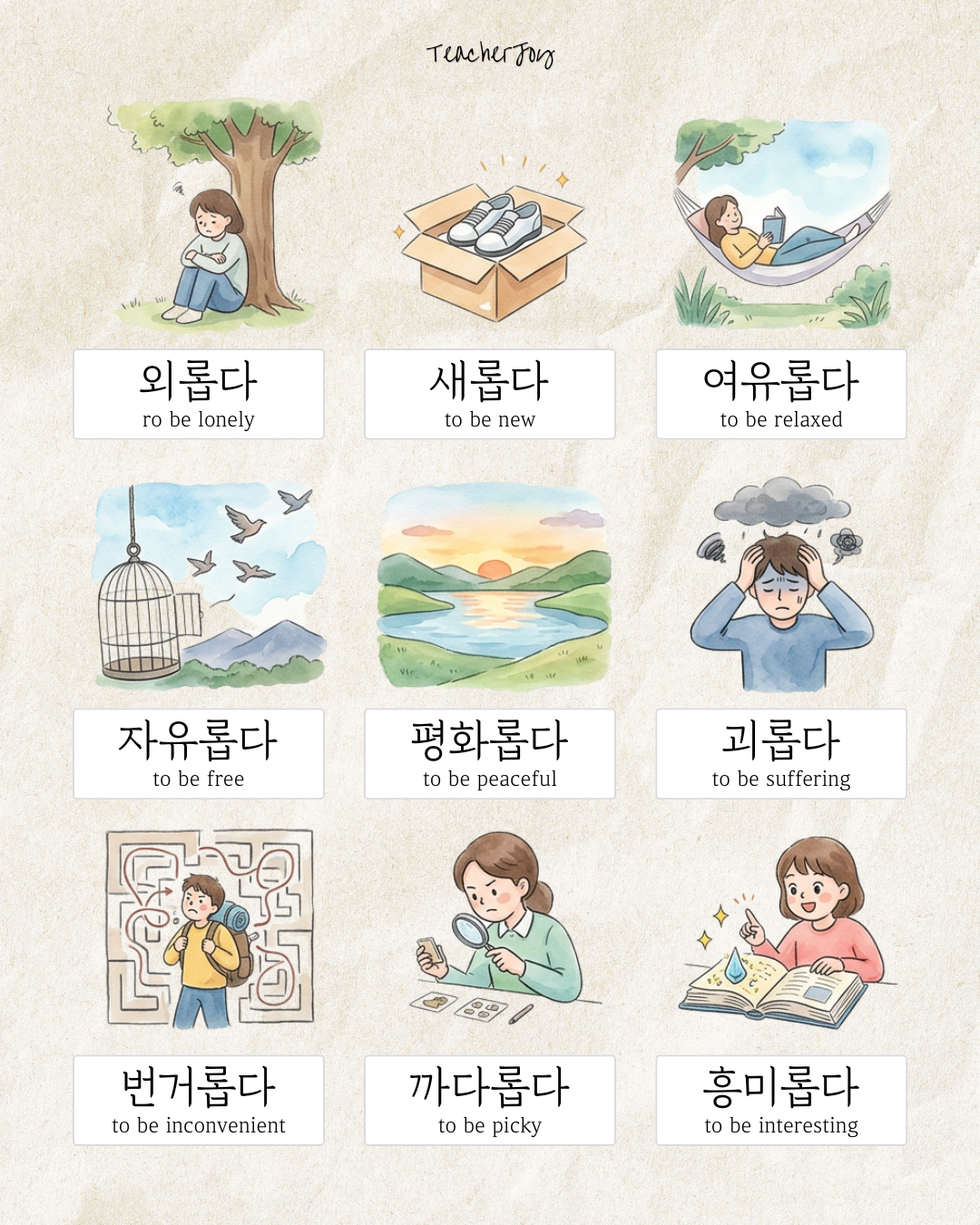
- 외롭다 (2급): to be lonely, to be solitary
- 새롭다 (2급): to be new, to be fresh
- 여유롭다 (餘裕-롭다, 3급): to be relaxed, to be easygoing
- 자유롭다 (自由-롭다, 3급): to be free
- 평화롭다 (平和-롭다, 4급): to be peaceful
- 괴롭다 (4급): to be suffering
- 번거롭다 (4급): to be inconvenient, to be annoying
- 까다롭다 (←까닭-롭다,4급): to be complex, to be picky
- 흥미롭다 (興味-롭다, 4급): to be interesting, to be exciting

- 지혜롭다 (智慧-롭다, 4급): to be wise
- 해롭다 (害-롭다, 4급): to be harmful, to be bad
- 날카롭다 (4급): to be sharp, to be pointed
- 향기롭다 (香氣-롭다, 5급): to be fragrant, to be scented
- 슬기롭다 (5급): to be wise
- 다채롭다 (多彩-롭다, 6급): to be varied, to be colorful
- 위태롭다 (危殆-롭다, cf. 위태하다, 6급): to be risky, to be critical
- 신비롭다 (神祕-롭다, cf. 신비하다, 6급): to be mysterious
- 대수롭다 (6급): to be significant, to be important
- 경이롭다 (驚異-롭다, 6급): to be marvelous, to be wonderful